7TH CANADIAN RECCE, 3RD CANADIAN INFANTRY DIVISION
D-DAY Regiment
MOTTO: NON NOBIS SED PATRIÆ (NOT FOR OURSELVES BUT FOR OUR COUNTRY)
HEADQUARTERS LOCATION: MONTREAL, QUEBEC, CANADA
The 6th Duke of Connaught's Royal Canadian Hussars (Armoured Car) mobilized an armoured squadron designated the '5th Canadian (Armoured) Division Headquarters Squadron (6th Duke of Connaught's Royal Canadian Hussars), CAC, CASF' for active service on 27 February 1941. This unit embarked for Britain on 11 November 1941. It was disbanded on 1 January 1943 and its personnel absorbed by Headquarters, 5th Canadian Armoured Division.
Details of the 17th Duke of York's Royal Canadian Hussars were called out on service on 26 August 1939 and then placed on active service on 1 September 1939, under the designation '17th Duke of York's Royal Canadian Hussars, CASF (Details)', for local protection duties.
The details called out on active service were disbanded on 31 December 1940. The regiment subsequently mobilized the '3rd Canadian Motorcycle Regiment, CASF (17 H)' for active service on 24 May 1940.
It was redesignated '17th (Active) Duke of York's Royal Canadian Hussars, CASF' on 1 February 1941 '7th Reconnaissance Battalion (17th Duke of York's Royal Canadian Hussars), CAC, CASF' on 11 February 1941 and '7th Reconnaissance Regiment (17th Duke of York's Royal Canadian Hussars), CAC, CASF' on 8 June 1942. It embarked for Britain on 23 August 1941.
Detachments of the regiment landed in Normandy as part of the 3rd Canadian Infantry Division on 6 June 1944, followed by the remainder of the regiment in the course of June and July 1944. The unit fought in North West until the end of the war.
The regiment was disbanded on 15 January 1946.Footnote 48 A '2nd 7th Reconnaissance Regiment, CAC, CAOF' was mobilized for service with the Canadian Army Occupation Force on 1 June 1945. It was redesignated the '2nd 7th Reconnaissance Regiment, RCAC, CAOF' on 2 August 1945. This regiment was disbanded on 24 May 1946.
(source: Canada.ca)
On October 4, 1944 Major W.C. Bowen (the acting commanding officer) was called to Div H.Q. to attend an Officers meeting that initiated ‘Operation Switchback’. The 3rd Canadian Division had been given the task of clearing the enemy from the area north of the Leopold Canal, East Flanders, Belgium. The Major discussed the general plan with the Squadron Commanders which was as follows: 7 Cdn. Inf. Bde. (Canadian Scottish 1bn. (C.S.), Regina Rifle Regiment (R.R.R.), Royal Winnipeg Rifles (R.W.R.)) was to make an assault crossing the Leopold Canal, being ferried across by the North Shore (New Brunswick) Regiment (N.S.R.) of 8 Cdn. Inf. Bde. With the objectives of Eede (NL), Middelburg (B) and Aardenburg (NL). After this the Engineers were to put down a class 40 bridge. The N.S.R. was to follow up, pass through 7 Cdn. Inf. Bde. And fan out in the north west direction. The 7 Recce task was to follow close on the heels of the N.S.R. and take over the 7 Cdn. Inf. Bde. positions. Objectives were: A Sqn. Eede (NL), B Sqn. Aardenburg (NL) and C Sqn. Middelburg (B).
October 6, 1944 was the day to launch the plan but it was quickly realised that the 7 Cdn. Inf. Bde. was having great difficulty with their assault. R.R.R. and C.S. were pinned down by heavy enemy fire. After dark A Sqn. 7 Recce and 56th Anti-Tank Battery were sent in as infantry to reinforce the Canadian Scottish.
The next day the R.W.R. were sent to try and link up the gap between the C.S. and R.R.R. The enemy was determined to hold their ground and they fought fanatically. The enemy shelling was the heaviest they had experienced since D-Day.
The push through seemed impossible. The Leopold Canal, actually 2 canals parallel to each other were defended with old bunkers from the ‘Holland Linie’, flooded land and heavy artillery. The 4th Armd. Div. also faced strong resistance and were held up at the Isabella Canal for 2 weeks. Therefore a 3rd front needed to be established. It became the task of the 9 Cdn. Inf. Bde. (Highland Light Infantry of Canada (H.L.I. of C.), North Nova Scotia Highlanders (N.N.S.H.) and Stormont, Dundas and Glengarry Highlanders (S.D.G.)). A beach between Biervliet and Hoofdplaat (NL) was divided into Green Beach and Amber Beach. During the night of October 8/9, 1944 the highlanders crossed the Western Scheldt from Hoek (NL) in Buffalo’s, because the Braakman Inlet (now reclaimed land) was considered too dangerous to cross. The H.L.I.of.C. established a small beach head at Paulina Beach. The N.N.S.H. landed west of them and the S.D.G. west of the Nova’s.
On October 10, 1944 the 7 Recce came under command of 9 Cdn. Inf. Bde. During the late afternoon Major C.A. Bearman and Lieutenant R. Haran went ahead to the new Tactical H.Q. and made contact with the H.L.I.of.C. During the night and morning of the 11th A,B,C, Sqn. were ferried across from Hoek (NL) to Paulina, just like the 9 Cdn. Inf. Bde. did before.
In the early morning (6 am) of October 11, 1944 the H.L.I.of.C. was relieved by the 7 Recce and the highlanders from Galt, Ontario pushed on towards Biervliet with the N.N.S.H. on their left (Driewegen area). That day the 7 Recce flushed a great number of Germans out their foxholes in the dykes with their flame-throwing carriers (WASP). The war diary reports Sgt. W. MacKay as their only fatal. Sadly no words about the Senegalese soldier. Both soldiers were killed whilst escorting POW’s.
The next day at 2 pm the Sqns moved south and again the Wasps were very effective. A and C Sqn. reached their objectives quickly but B Sqn. had to deal with bogged down Wasp’s. They came under heavy fire. Major MacLean and his officers came up with the plan of using 6-pounders. These Anti Tank guns were under command of Lt. Sheppard and Lt. Le Blanc to support B and C Sqns. Sgt. Scott was later rewarded the Military Medal for his part in the action. Sgt. Giles was decorated with the same medal for his actions that day. Two Wasps were in the lead and both bogged down in the mud. The whole section came under fire of three 20mm guns. The Sergeant led the section to the first objective, clearing the enemy out with grenades and machine guns. The enemy started to fire from the opposite bank. Sgt. Giles single handed moved on another 900 metres and eliminated all opposition. As a result, an entire German company was taken prisoner or killed. B and C Sqns could therefore advance without delay. The war dairy claims 170 pow that day. Trooper P.F. Vernham was killed when the Wasp he was in ran over a mine and destroyed the entire front-end of the vehicle. A report by Lt. Doig notes that Sgt. N. Tietlebaum was missing in action.
On October 13, 1944 the 7 recce came back under command of 8 Cdn. Inf. Bde. In the morning the N.S.R. and Queen’s Own Rifles of Canada (Q.O.R.of.C.) had to task to join up with 10 Cdn. Inf. Bde. of the 4th Armd. Div. (Algonquin Regiment, Argyll and Sutherland Highlanders of Canada, Lincoln and Welland Regiment.) C Sqn. was switched over to the north-west to fill in the gap between S.D.G. and N.N.S.H. (Hoofdplaat/Driewegen, NL). B Sqn was given the task of proceeding on the left flank of N.S.R. And A Sqn. moved back close to the landing zone.
On October 14th, 1944 C Sqn. was still in position between Biervliet and Driewegen (NL). They lost Trooper W. Rezansoff to mortar fire.
B Sqn. continued their advance left of N.S.R. (Kapitalen Dam). At about 4 pm Rear H.Q. and A Sqn. had a close call from a Typhoon air attack, which dove on a target in front of the forward troops. The 7 Recce was not affected but elsewhere there were casualties caused by friendly fire. Lt-Col. T.C. Lewis DSO MID CDG reported both 8 Cdn. Inf. Bde Regiments Queen’s Own Rifles of Canada and Regiment de la Chaudiere had done well in their advance and were expected to link up with the Algonquin Regiment by nightfall.
On the 15th the advance went westwards in the direction of Watervliet (B). B Sqn. moved along with the N.S.R. just above the border with Belgium. C Sqn. was relieved by the N.N.S.H and S.D.G. and so they could move south and advance west in the flooded area between the Leopold canal and the N.S.R. A Sqn. moved from Biervliet and became a back up for C Sqn. One troop was detailed to go down and fill the gap between the maintenance route and the Leopold canal. This route was established by 1200 hours by the Engineers in the Isabella area with first priority for M-10 tanks.
In the afternoon B Sqn. managed to link up with A Company of the Argyll and Sutherland Highlanders of Canada (4th Armd. Div.) in the area of Watervliet (B).
John Maxwell Ridley CDG suffered a bullet wound at the upper arm / shoulder and was evacuated to a Military hospital in Gent, (B). The next morning at 9 am the Sergeant was pronounced dead.
The Regiment was ordered to move west during October 16, 1944. A and C Sqns had to operate in the flooded area of Watervliet (B), Waterland-Oudeman (B) and Sint-Jan-In-Eremo (B), north of the Leopold canal to link up with 7 CIB (Canadian Scottish, Regina Rifle Regiment, Royal Winnipeg Rifles). B Sqn. was part of the operation to encircle ‘IJzendijke’ by the infantry of 8th and 9th Bde. They approached from the south of the small city. The North Shore Regiment again suffered a friendly fire attack from the R.A.F. after they earlier that day took over control of the customs border post at ‘Veldzicht’ (NL).
The recce guys from C Sqn. also had trouble with friendly fire from Canadian artillery after progressing through waist-high cold water. As well road blocks from chopped trees. Then they came under fire from a German 88, which knocked out the lead vehicle in the area of Watervliet (B). Great credits to Corporal Lyons for volunteering to take out the gun with a PIAT (anti tank gun). After a few shots at close range, he succeeded to knocked out the 88 and helped evacuate a wounded soldier. Cpl Lyons was awarded the Belgium Croix de Guerre for his actions.
The 17th marks a dark day in the Regimental history. It’s the day that Lt-Col. T.C. Lewis DSO MID CDG, who was quite loved amongst the boys for being in the front line to observe the actions, was killed by friendly artillery fire. A the 8 CIB’s commanding Officer, he was in advance to link up with the Regiment de la Chaudiere when their Jeep came under fire at Balhofstede, just south of IJzendijke (NL). Lewis and his driver managed to dive into a ditch for cover from a German MG42 machine gun. As they were pinned down a friendly artillery shell hit their position, killing Thomas instantly. The driver was taken prisoner and found wounded the next day by the Chauds. The Germans withdrew late at night. The rest of the day, not knowing about what happened to Lewis, B Sqn. had to deal with mines, fallen trees and booby traps. They had to wait for Engineers to clear the path.
The Queen’s Own Rifles of Canada liberated the historical town of IJzendijke. The Hussars, N.S.R. and Chauds acted from the southern area and the Nova’s from the northern area. The next day Charlie Coy from the Chauds found the body of Lewis, stripped of all his personal effects.
This day the Regiment moved westwards to make contact with the 7 CIB. A Sqn. made very little progress. The promised Buffalos did not arrive, so the boys had to act like infantry men and wade through the water chest high in an attempt to reach Moershoofde (B). B Sqn. advanced to Waterland-Oudeman (B) The Royal Canadian Engineers of 6th Field Company managed to collect 42 mines. The same amount of Germans were taken prisoner. C Sqn. had patrols at Sint Margriete (B). The attempt failed. The Chauds of 7 CIB were in the area of ‘Linie of Passageule’, just south of Turkeye (NL).
For days the moral in the German Army was poor and many tried to find a way to give themselves in without being shot by their own higher ranks. Not all were prepared to give it up that easy. Amongst the Germans there were hardened veterans from the eastern front. They went through hell already and were prepared to fight to the last bullet.
On October 19, 1944 the task was the same as the day before. This day was more fruitful. A Sqn. still waiting for Buffalos, which only showed up late afternoon. Three troops acting as infantry proceeded on foot along the Leopold Canal towards Moershoofde (B) (About 7 or 8 km from where C Sqn. made their patrols the day before.) without meeting the enemy. However, they made contact with the British 52nd recce, who had orders to mortar the place. B Sqn. proceeded to Het Eiland (NL). C Sqn. plowed through difficult terrain obstructed by mines and fallen trees but managed to reach Aardenburg (NL). The mayor ‘burgermeester’ offered the city hall for H.Q. (which was only just left by the Germans.) The Canadians made contact with members of the British Highland Light Infantry in the town. Due to the large gap between B and C Sqn. the order from Major Bearman was given to C Sqn. to link up with B. Sqn. Lt. E.W. Smith was given this task and at 7.30 pm took position south of St. Kruis (NL) at Groote Gat.
The Regiment lost Howard Meredith. It is uncertain what killed the 22-year-old from Barrie, Ontario. B Sqn. came under enemy artillery fire. It’s plausible that this is what sealed the young trooper’s fate. By the 20th of October the Germans established Oostburg (NL) as their strong hold. The battle for city became the task of the Queen’s Own Rifles of Canada (8 CIB). It took nearly 1 week to liberate the town. It was completely destroyed by artillery and bombing by the R.A.F. Even the red cross post (which is still today the location of the city’s hospital) was not spared. Locals feared for their lives in their cellars. After the war an entire new street plan was drawn for Oostburg (NL). It meant that not all the locals were very pleased with the allied liberators. It’s the day that the 17th Duke Of York’s closed the gaps between the lines. B Sqn. advanced to Bakkersdam (NL). They made contact with their French- speaking fellows, the Chauds of 8 CIB.
The next day the three Squadrons had to penetrate through the enemy mine belts. C Sqn. was ordered to take up positions along the main road (Aardenburg, NL area). A mission without casualties, although heavy Arty fire. A and B were to advance in the same general directions. After some harsh days they were told to be relieved by the British 52nd recce the next day and to come back to a rest area with a possible take-over of the N.S.R. (8 CIB) in the area of Schoondijke (NL), liberated by the Highland Light Infantry of Canada (9 CIB).
October 22, 23 and 24 were indeed relative calm for the Regiment. They even were allowed to watch The Canadian Army Show - Unit ‘A’ in the Golden Lion theatre in Eeklo (B). Twentynine members each day. It was a much appreciated relieve for the guy’s.
However on October 24, 1944 Lt. L.E. Stephen of C Sqn. came to a house occupied by 30 civilians. He was told a German Officer was in the basement. At first the Lieutenant wanted to approach with a grenade and pistol but then decided to ask his driver for help. Just as he reached the vehicle the area came under heavy fire, and they were ordered to return to their Sqn. H.Q.
On October 25, 1944 the battle for Oostburg (NL) started. This task was given to the Queen’s Own Rifles of Canada. C Sqn. had to move from Aardenburg (NL) and take position south of Oostburg (NL). They had to take the long route, as far as back to IJzendijke (NL), to sweep around the enemy lines. A Sqn. had to link up with the British 52nd recce. A and B managed to scare out 9 Germans by using their Wasp on the enemy dugouts.
Meanwhile C Sqn. found great difficulty trying to link up with the Q.O.R.of.C. from roadblocks and heavy shell fire. At 3.30 pm Lt. Stannard finally was able to make contact with the Queen’s Own.
The next day started with a small but important task. The main road between Draaibrug (NL) and Oostburg (NL) (Nieuwstraat) had to be cleared and consolidated. This in order to let the Engineers erect a bridge at area of Paviljoenweg (not to be mistaken with the same road name near Paulina.) During the night the bridge was established, which shortened the route by quite a lot.
C Sqn. had to clear a roadblock at the crossing Bakkersstraat/ Nieuveltweg (NL). In doing so Captain Whittingham’s scout car ran over a mine. The Officer was blown out the vehicle. Then a second mine exploded causing the car to tip over on top of the Captain. He was instantly killed.
Sergeant Edwin Wellington advanced alone some 200 metres. Under enemy fire and in some places with his legs under water (remember late October, so that must be pretty cold) he found a spot to open fire on the enemy. After a few bursts of fire he went back to his line and hoped his actions paid off. As he came back the road was cleared and he led the men into enemy positions. They even managed to take a number of prisoners. The Sergeant was later awarded the Military Medal.
A Sqn. came under enemy mortar, 20mm and machine gun fire. Lieutenant John Thomas Pullam observed the situation and advanced under fire, then knocked out the enemy using grenades. Some were killed and 20 others surrendered. He was later awarded the Military Cross.
It was not only raining shells but it was also raining awards for exceptional bravery in the field. On October 27, 1944 Lieutenant Lorne Walter Kay Crabtree was also awarded the Military Cross. As his section was held up south west of Oostburg (NL) by a 20mm and machine gun fire that came from a dyke in front of them. Crabtree led a patrol to the dyke, under heavy fire. He gained the objective and held it against two counter-attacks.
On October 28, 1944 and A Sqn. still had to take guard on the bridge established by the Engineers. C Sqn. advanced towards Cadzand (NL), another stronghold for the Germans. So, the Canadians had to deal with strong opposition. One Wasp was blown by a mine. This caused plausibly Wilson’s life.
An armoured car commanded by Sergeant Joseph Young came under mortar and machine gun fire. With all tires shredded the advance went on. On the go he threw grenades out of the turret. 15 Germans turned themselves in. Young ordered the gunner to engage, and he dismounted from the vehicle. With some assistance he cleared the road of mines. For his actions the Sergeant was awarded the Military Medal.
The following day the task of A Sqn. remained the same. B Sqn. advanced without resistance. C Sqn. on the right flank of B Sqn. met heavy opposition. However, the war diary doesn’t report any casualties that day. The objective was to follow the Uitwateringskanaal towards Sluis (NL).
With the end of the month in sight it was also nearing the wrap up of Operation Switchback. After weeks of ploughing through sticky mud, being cold and wet in the rain, hiding in ditches filled with water or moving through standing water. After seeing the death-swollen bodies of humans and animals. Little sleep, friends wounded or killed. After being attacked by friendly fire and pounded by the enemy there is this final chapter for the 17th Duke’s of York, Royal Canadian Hussars before their next mission for the liberation of North West Europe.
On October 30, 1944, the task to attack Sluis (NL) was given. However, machine guns and mines limited the advance. The Germans were giving a good show. The Hussars advanced towards the town from the north, 3rd Anti-Tank were on their left and the Chauds on the right.
Corporal MacKenzie, an original member of the unit, was killed by a sniper at Heilleweg, south east of Sluis (NL).
At 4 pm on the last day of October and the Hussars were relieved by the 3rd Anti-Tank Regiment (also a D-Day unit). Then they moved towards Zeebrugge (B) where they took over from the British 52nd recce. But due to bad communication the Brits were not informed so the take over suspended for the next day.
On November 1st had A Sqn. found themselves at Lissewege (B), an area between Brugge (B) and Zeebrugge (B). B Sqn. situated in the area of Damme (B) (north east of Brugge (B). C Sqn. was in reserved in Brugge (B) (Already liberated by the 12th Manitoba’s on September 12, 1944.) A and B Sqns. came under considerable shell fire. But no fatalities.
Knut Ebering, the General of the German 64th Infantry Division, was captured at Oosthoek (B), just outside Knokke (B). A man who stoked fear amongst his men had his suitcase already packed before the Canadians of 9 CIB knocked at the door. After his prison sentence in The States he was released in June 1947. He died on April 3, 1978 in Erlangen (D).
On second day of November it was declared that Operation Switchback came to an end.
Written by Michael Van De Velde (by the use of official sources and help from Robert Catsburg).
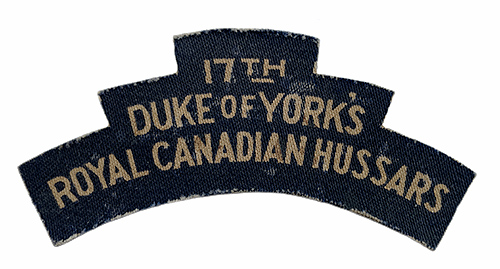
Credits: Photographs capbadge and Division patch: JM-Militaria. Shoulder title: Michael van de Velde.