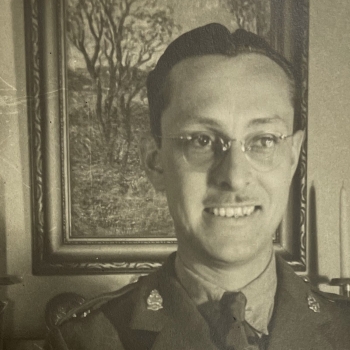
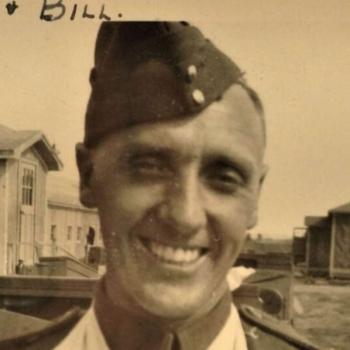
Military Service Record: Library and Archives Canada (LAC).
War Diary: 17th Duke of York's Royal Canadian Hussars (7 Recce), Library and Archives Canada (LAC).
Casualty and burial information: Commonwealth War Graves Commission (CWGC).
Temporary burial photograph: Eeklo Archive, Belgium.
Headstone photograph: Michael van de Velde.
Howard William MEREDITH

Military Information
Service Number
A/105478
(No.1 District Depot, London, Ontario)
Rank at Death
Rank History
1942-12-07
|
Private
1943-02-24
|
Trooper
Engagement
Taken on Strength
1944-06-30
|
17th Duke of York's Royal Canadian Hussars
Overseas
1943-07-17
|
United Kingdom
Disembarked
1944-06-12
|
France
Campaigns & Operations
Date of Death
Circumstances of Death
Killed in action
Personal Information
Birthdate
1922-05-17
Birthplace
Age
22
Parents
William Henry and Minnie Meredith (née ??)
Marital Status
Single
Religion
Occupation
War Diary
19 October 1944
Lt-Col Lewis's body was picked up at CCP and brought to RHQ as Major Baerman had made arrangements for the funeral. At 0930 hrs, Lieut R. Haran accompanied by Tprs. Daniels and Molson, the Col's driver and batman, proceeded to Maldegem, East Flanders, Belgium (0098) with the body where they were joined by 20 Other Regimental Officers and RSM Knights. The funeral service was conducted by H/Capt M.J. Stewart, C. of E. Padre from 8th Cdn Inf Bde HQ. The pall bearers were Majors W.C. Bowen, D.C. MacKenzie, Capts J. Whittingham and J.M. Thom. The Lt-Col was buried in Row D, Grave No 23 MR 006998, about one half mile north of Maldegem.
The Squadrons were again ordered to push forward and link up with the 7th Cdn Inf Bde. A Squadron were still waiting for the Buffalos which did not show up until late afternoon, too late to be of any use that day. However, three of their troops proceeded on foot along the Leopold Canal and got as far as Moershoofde, East Flanders, Belgium (0502), without meeting any opposition. There they contacted patrols of the 52nd Recce Regt, just west of the town who had been sent out to mortar the place. B Squadron managed to get as far west as St. Jores-Het Eiland Dam area, and late in the afternoon C Squadron managed to push on to Aardenburg, Zeeland, The Netherlands (0005) in spite of difficult road conditions, mines and fallen trees. Lieut Banks' troop was the first to enter Aardenburg, followed immediately by Squadron HQ. Here they met a Coy of 6 HLI, part of the 157 British Bde of the 52nd Division. This Coy had entered Aardenburg from the south at approximately the same time as C Squadron had entered from the east. 30 PWs were taken and placed in the local jail.
The Burgomaster greeted the Squadron and offered them the use of the City Hall as a HQ. The offer was accepted and the Sqn HQ was set up in the Rathaus cellar, which had been a German HQ a few hours previous. This created a very uneasy feeling in RHQ due to the large gap between C Squadron's right and B Squadron left flanks.
Major C A Baerman immediately ordered C Squadron to establish contact with B Squadron. Lieut E W Smith was ordered to make this contact and at 1930 hours took up positions in St. Kruis (0405).
Awards & Medals

1939-45 Star
The 1939-1945 Star is a Second World War medal that was issued between 02 September 1939 and 08 May 1945 (Europe) or 02 September 1945 (Pacific). The medal was awarded for six months service on active operations for Army and Navy, and two months for active air-crew. Battle of Britain - This bar was awarded to those members of the crews of fighter aircraft who took part in the Battle of Britain between 10 July and 31 October 1940. The Bomber Command - For Veterans who served with the British Forces, the bar is worn on the 1939-45 Star. For Canadian Armed Forces Veterans, the bar is worn on the Canadian Volunteer Service Medal.
France and Germany Star
The star was awarded for one day or more of service in France, Belgium, Holland or Germany between 06 June 1944 (D-Day) and 08 May 1945. If later entitled to the Atlantic star, the ATLANTIC bar would be worn. The Aircrew Europe Bar is not issued with this star because one could not qualify for that star after 05 June 1944. Regulations only allow one bar to be worn with the Star. When the ribbon is worn alone, a silver rosette ribbon emblem is worn to denote the award of a bar to the medal.
Defence Medal
Although the medal was usually awarded to Canadians for six months service in Britain between 03 September 1939 and 08 May 1945, the exact terms were: Service in the forces in non-operational areas subjected to air attack or closely threatened, providing such service lasted for three or more years. Service overseas or outside the country of residence, providing that such service lasted for one year, except in territories threatened by the enemy or subject to bomb attacks, in which case it was six months prior to 02 September 1945.
Canadian Volunteer Service Medal
The CVSM is granted to persons of any rank in the Naval, Military or Air Forces of Canada who voluntarily served on Active Service and honourably completed eighteen months total voluntary service from 3 September 1939 to 1 March 1947. A silver bar (often called a clasp), a maple leaf at its centre, was awarded for 60 days service outside Canada. A silver maple leaf is worn on the ribbon in undress. The Bomber Command Bar is awarded to Canadian Veterans who, regardless of rank or role, served a minimum of one day with Bomber Command between 3 September 1939, and 8 May 1945 (Victory in Europe Day). Recognizing that the successes of Bomber Command started on the ground and finished in the air over Fortress Europe, all Canadian Bomber Command Veterans who earned the CVSM, regardless of rank or role, are eligible for the honour. The Dieppe Bar is awarded to those who participated in the Dieppe Raid on August 19, 1942, and is worn on the CVSM ribbon. A silver bar, to be attached to the ribbon of the CVSM has been designed featuring the word DIEPPE in raised letters on a pebbled background. Above this, the bar bears an anchor surmounted by an eagle and a Thompson sub-machine gun. The design was created in consultation with the Dieppe Veterans and Prisoners of War Association.
War Medal 1939-1945
The medal was awarded to all full-time personnel of the Armed Forces and Merchant Marines for serving for 28 days between 03 September 1939 and 02 September 1945. In the Merchant Navy, the 28 days must have been served at sea. A single oak leaf emblem is worn to signify a Mention-in-Despatches and the silver oak leaf signifying a King's Commendation for Brave Conduct is worn on this medal. There is no bar other than these emblems.
Temporary Burial

Headstone
Image
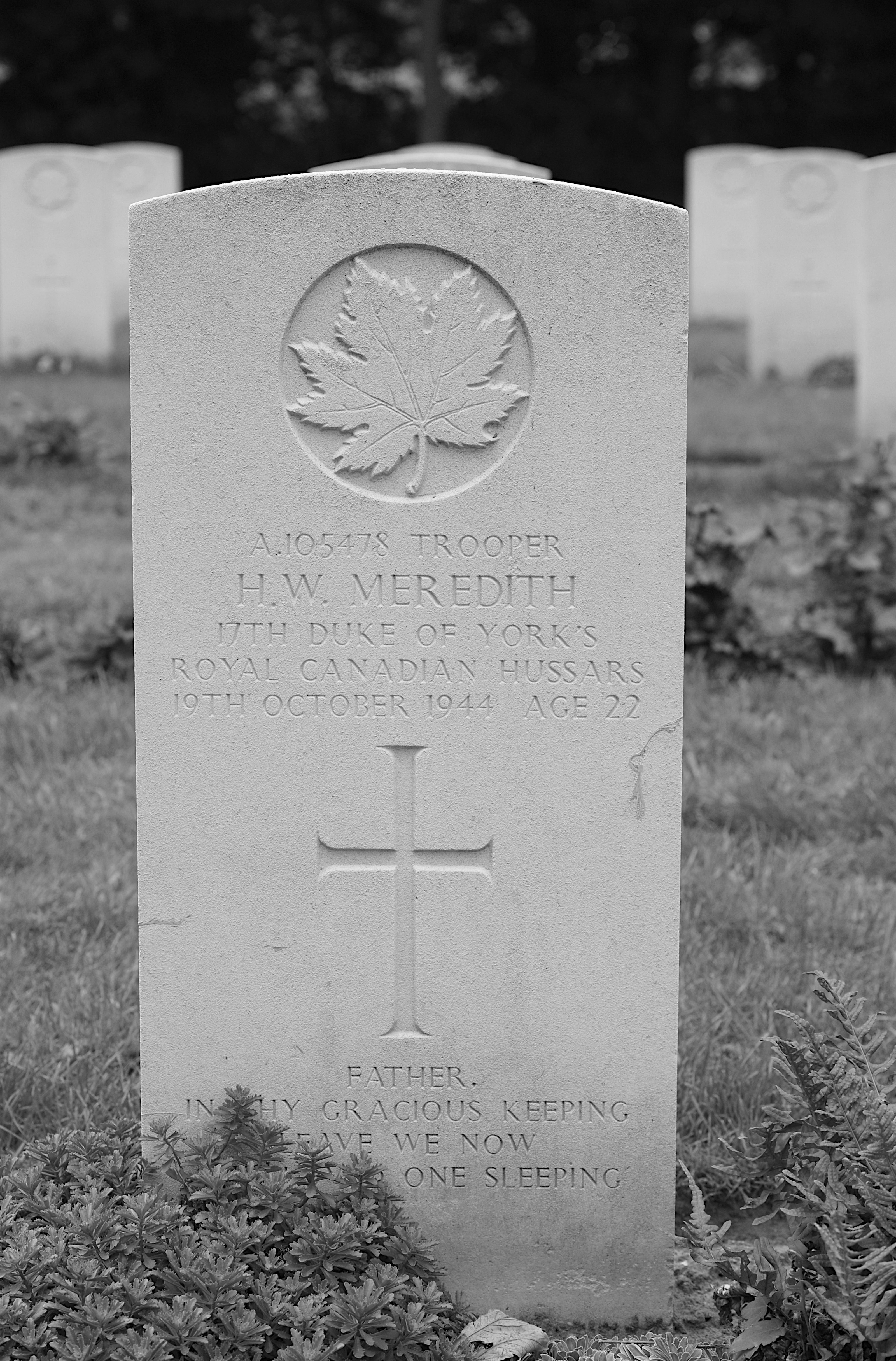
Plot 9 | Row D | Grave 6
FATHER, IN THY GRACIOUS KEEPING LEAVE WE NOW OUR LOVED ONE SLEEPING